Yarn Swift and Winder: The Set That Turns a Hank Into a Ball
If you only need one half, the umbrella swift and the hand crank ball winder each have their own page. This page is about why almost everyone ends up with both.
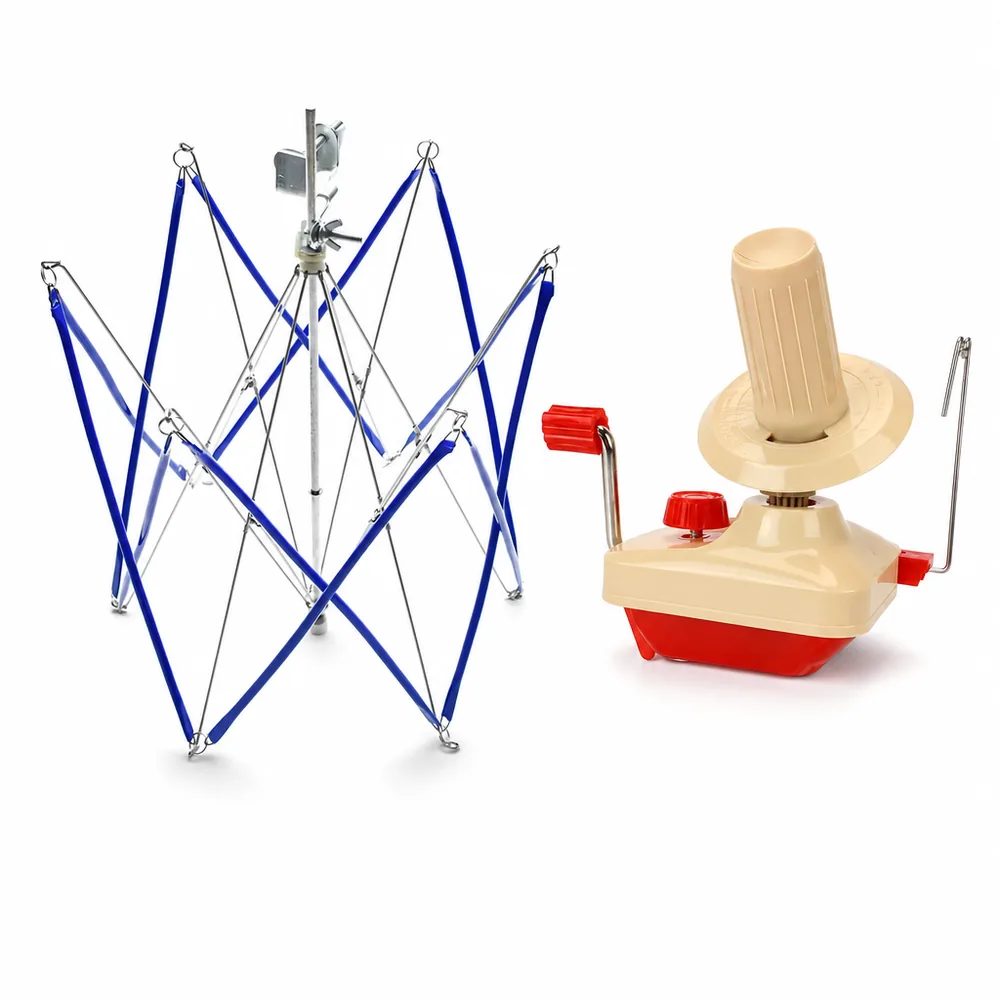
The winder appears in the swift's own instructions
That distinction matters because a set is exactly the kind of thing a retailer invents to raise an average order value. So here is the chain of evidence, and you can hold us to it. When we specified the swift we worked from the full specification block rather than from photos. That block gives the height, the open size, the materials, a declared measuring tolerance, and one line describing what the tool is for. That line names a winder. Nobody at Skeinwright wrote it, and it was written before we existed as a shop.
The winder came as a separate product, in a separate order, with its own parts diagram and its own assembly instruction. The two documents were never meant to be read together. They describe the same two-tool workflow anyway, because that workflow is how yarn has been prepared since long before either factory opened.
Two documents, two factories, one workflow
| Source document | Product it describes | What it says about the other tool |
|---|---|---|
| Umbrella swift specification block | The swift, iron skeleton, 21.65 in open | Describes unwinding a twisted hank for use with a ball winder |
| Ball winder parts diagram and assembly note | The winder, six named parts | Describes a spindle that builds a ball from a fed strand, which is what a swift supplies |
| Relationship between the two | None | Two unrelated designs, with no shared parts |
We are not claiming the two tools were tested against each other. We are claiming that each one, independently, describes a job that the other one finishes.
Hank to center-pull ball, in four moves
| Stage | Tool | What happens | What goes wrong without it |
|---|---|---|---|
| 1. Open the hank | Your hands | Untwist, find both ends, cut the ties | Cutting a tie before untwisting turns the hank into a knot |
| 2. Hold it open | Umbrella swift | Ribs spread the loop taut and rotate as yarn is drawn off | A chair back or a pair of arms loses tension unevenly and the loop folds in |
| 3. Wrap it | Ball winder | Yarn guide feeds the strand, spindle builds crossing layers | Hand winding tightens the ball and stretches the yarn as it grows |
| 4. Lift it off | Your hands | Straight up, hollow centre intact, tail tucked inside | Twisting the ball off collapses the centre and kills the centre pull |
The whole sequence is one continuous motion once both tools are clamped. You are not stopping to re-tension, re-seat the loop or chase a rolling ball across the floor. That is the actual benefit of the pair, and it is why we sell them together rather than hoping you come back for the second one. Step by step photographs are in the how to use a yarn swift guide.
The two tools in the set
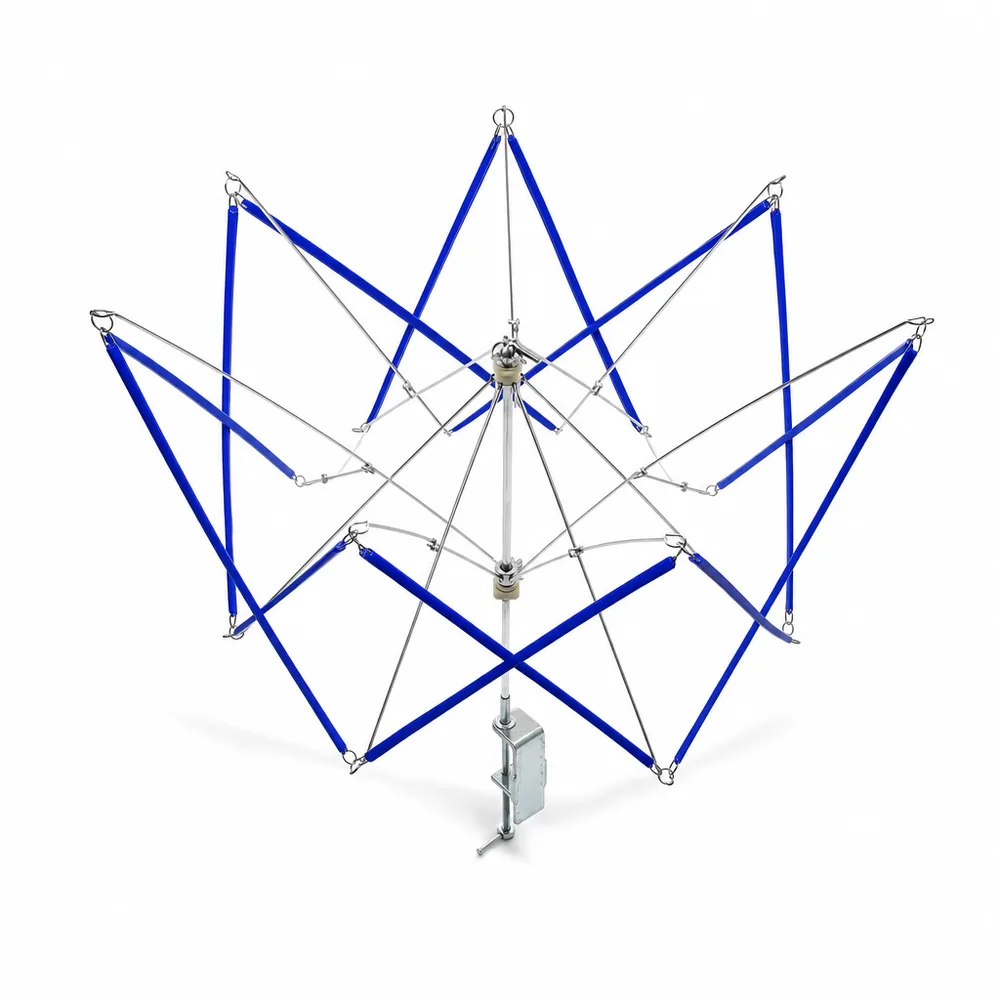
Umbrella swift
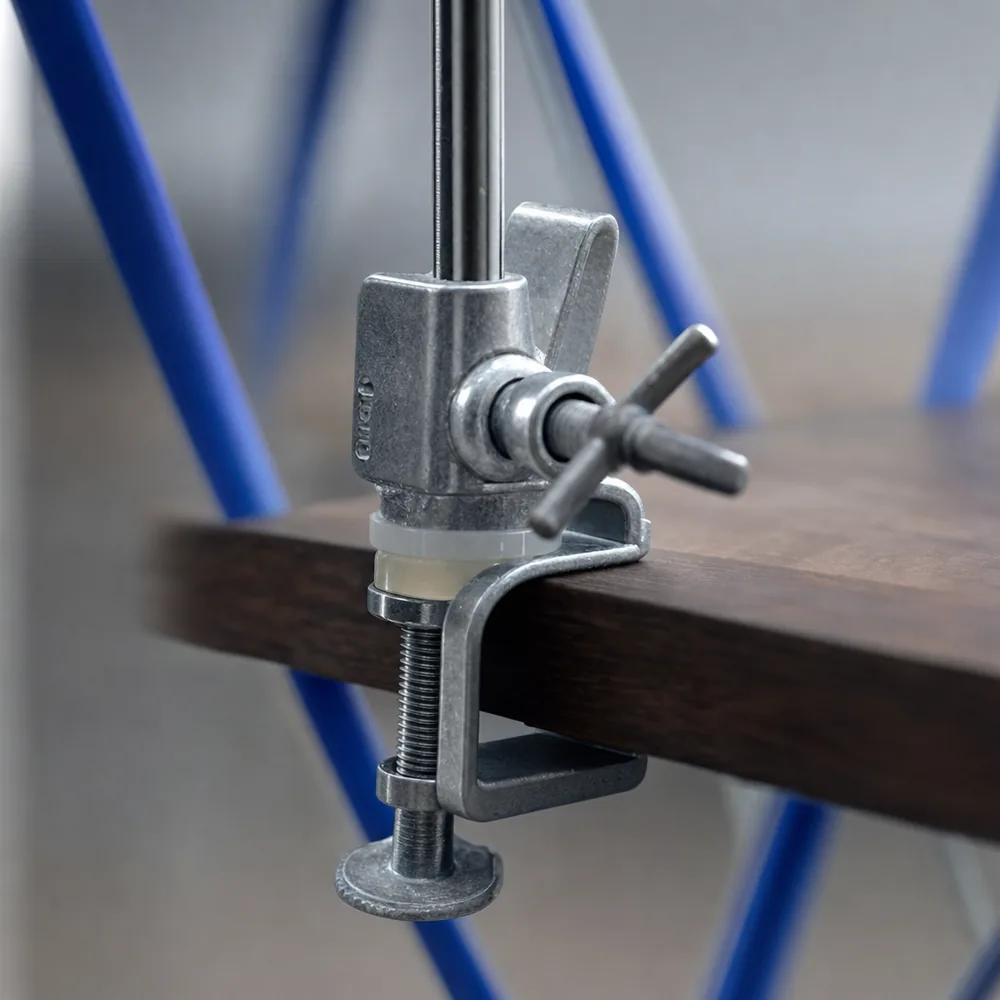
The holder. Iron skeleton with plastic bushings at the joints, coated blue, mounted on a screw table clamp. You open the ribs only as far as the hank needs, so the working diameter matches the yarn instead of fighting it. It collapses flat for storage, which is the reason it wins over a fixed cross-arm swift in a house with one table.
$39.95 on its own. Full detail on the umbrella swift page.
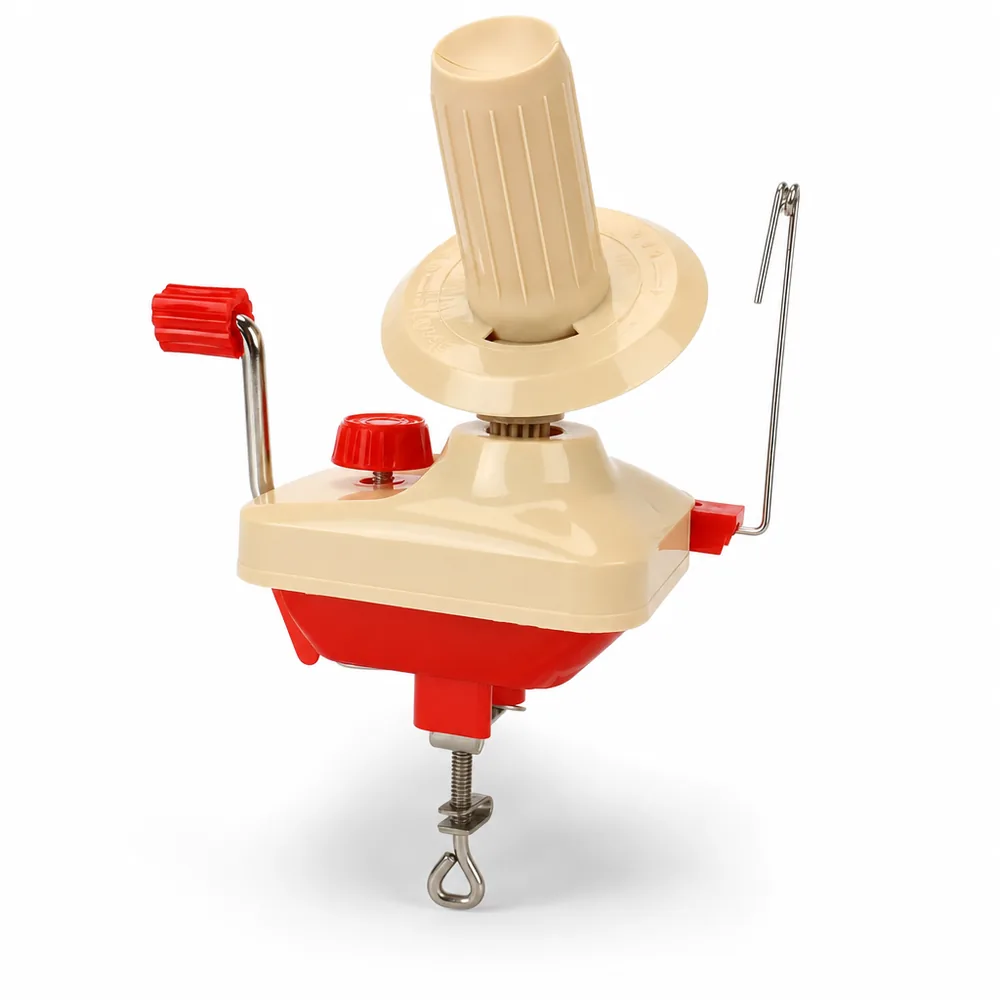
Hand crank ball winder
The shaper. Cream body with a red crank, a geared base that turns the spindle faster than your hand turns the handle, and a yarn guide that sets the feed angle so the layers cross. Assembly is one clockwise turn of the spindle into the base. No motor means you set the speed and feel a snag the moment it arrives.
$24.95 on its own. Full detail on the yarn winder page.
What the combo actually saves
| Route | Price | Deliveries | What you end up with |
|---|---|---|---|
| Umbrella swift alone | $39.95 | 1 | Hanks held open, still wound by hand |
| Ball winder alone | $24.95 | 1 | Neat center-pull balls, hanks still a problem |
| Both at full price | $94.90 | 2 | The full workflow, before the current discount |
| Swift and winder set | $57.95 | 1 | The full workflow, $36.95 less, one parcel |
We are not going to pretend the discount is the reason to buy the set. The reason is that a swift with no winder leaves you hand winding, and a winder with no swift leaves you looking for something to hold the hank. The saving is simply what happens when you buy the two halves in one order.
The figures behind this set
Difference between the $57.99 set and the same two tools at $94.98 full price
— Skeinwright price list, 2026
Full open diameter of the swift in the set, 55 cm across the ribs
— Skeinwright specification block, 2026
Height of the ball winder in the set, 19 cm, with a 5.35 in footprint
— Skeinwright specification sheet, 2026
Verified buyer ratings of four stars and up across the two tools, 26 for the swift and 285 for the winder
— Skeinwright audit of the rating history, 2026
The two rating counts are very different because the products have very different histories. The winder has been sold in volume for longer; the swift is newer to us and has a short record. We publish both numbers separately rather than blending them into a single flattering average, and you can read the individual ratings on our reviews page.
Clamping both tools on one table edge
A dining table edge is the usual answer. The swift opens to 21.65 in (55 cm) across, so leave it that much clearance plus a little, and remember the ribs sweep as the frame turns. The winder is 5.35 in (13.6 cm) long and 3.54 in (9 cm) wide, so it asks for very little space. What it does need is a straight run of yarn from the swift to its guide, without a chair back or a fruit bowl in the path.
Check both clamps after the first hank. Screw clamps settle under vibration, and the swift's in particular is a basic piece of hardware on a tool at this price. We say the same thing on the swift page, where a five-star buyer says it more bluntly than we would. Everything about delivery, destinations and returns is on our shipping policy and refund policy pages, and you can reach us through our contact page if something arrives wrong.
Reviewed July 2026. See how we test and about Skeinwright.
Swift and winder combo questions
Why buy a yarn swift and winder together instead of one at a time?
Because they do two halves of one job. The swift holds the hank open and turns as the yarn leaves it; the winder wraps that yarn into a center-pull ball. Buying one without the other means doing the missing half with your knees, a chair back or a second person.
What does the set cost against buying them separately?
The set is $57.95. At full price the umbrella swift is $59.95 and the ball winder $34.95, so the two come to $94.90. The set saves $36.95 and ships as one delivery rather than two, free, in 6 to 10 business days.
Is the swift and winder pairing a marketing invention?
No. The product notes for the swift describe the tool as something you use to unwind a twisted hank so it can be used with a ball winder. The winder is a separate product with no connection to the first. Both describe the same workflow independently.
How much table space does the pair need?
Two clamp points on the same edge, far enough apart that the swift can turn freely without the yarn brushing the winder. The swift opens to 21.65 in (55 cm) across and the winder is 5.35 in (13.6 cm) long, so a standard dining table has room to spare.
Which one do I clamp first?
The swift, because it needs the most room and it dictates where everything else sits. Clamp it, open the ribs to match the hank, then clamp the winder within comfortable arm reach on the same edge and thread the strand through its yarn guide.
Can I still buy them one at a time?
Yes. Every option appears in the box above, and the swift and the winder each have their own page with full specifications. The set exists because most buyers who work from commercial hanks end up owning both anyway, and it is cheaper in one order.
Each tool on its own
Umbrella swift
Specifications, the folding mechanism, the table clamp, and a comparison against turned-wood and Amish style swifts.
Yarn winder
The six named parts, the assembly instruction word for word, and how to wind a ball step by step.
Guides and reviews
Read how to use a yarn swift, then see what buyers reported on the reviews page.