· Marguerite Aubin
Amish vs Umbrella Yarn Swift: Two Designs, Two Ways to Wind
Set the two side by side and they barely look related: a wooden cross turning flat above its base, and an upright mast at the table edge with its ribs spread in a circle. Yet they exist for the same reason: a twisted hank has to be held open and allowed to rotate, or the first firm pull turns it into a nest.
This guide compares the two designs as designs. Where the skein sits, how much of your table each one claims, how big a hank each can carry, how each behaves once yarn is actually moving, and where each goes when you finish. If your question is about wood against metal as materials, with price and lifespan, that is a different comparison and we wrote it separately in wooden vs metal yarn swift. New to the tool entirely? Start with what is a yarn swift, then come back for the duel.
One disclosure before the first round: Skeinwright sells an umbrella swift, not an Amish one. We will describe both shapes as they are, because a reader who buys the wrong geometry for their home returns it, and nobody enjoys that.
How an Amish swift carries a skein
The phrase Amish swift names a design, not a maker. Picture two hardwood arms crossed into an X, mounted flat on a vertical spindle so the whole cross spins parallel to the table. Pegs stand upright along the arms, and the untwisted hank lies down over those pegs like a wreath laid on a rack. To fit a different hank, you lift the loop and set it onto a different set of pegs, closer in or further out.
Gravity does part of the holding. The skein rests on the pegs rather than being stretched by them, so a delicate loop sits relaxed while it turns. The frame usually stands on a weighted base in the middle of the table, though some versions clamp to the edge or mount to a wall. The classic form is the tabletop one: low, flat, planted, spinning with the calm of a record player.
Everything about the design assumes the swift has somewhere to live: a permanent surface where it sits out, arms open, ready for the next hank. That is not a flaw, it is the character of the type, and it explains almost every line of the comparison that follows.
How an umbrella swift carries a skein
An umbrella swift takes the opposite approach to every one of those choices. The frame is a vertical shaft with ribs hinged along it, exactly like the object it is named after. A screw clamp grips the table edge from above and below, the shaft stands up from the clamp, and the ribs spread outward until the hank sitting around them is taut. Instead of lying on pegs, the skein is held open from the inside by the ribs themselves.
On our frame the numbers are published and short: the shaft stands 16.54 in (42 cm) above the clamp, the ribs open to any diameter up to 21.65 in (55 cm), and the skeleton is iron with plastic bushings at the pivots. When the last yard leaves the ribs, the frame collapses inward in one movement and closes to a narrow stick.
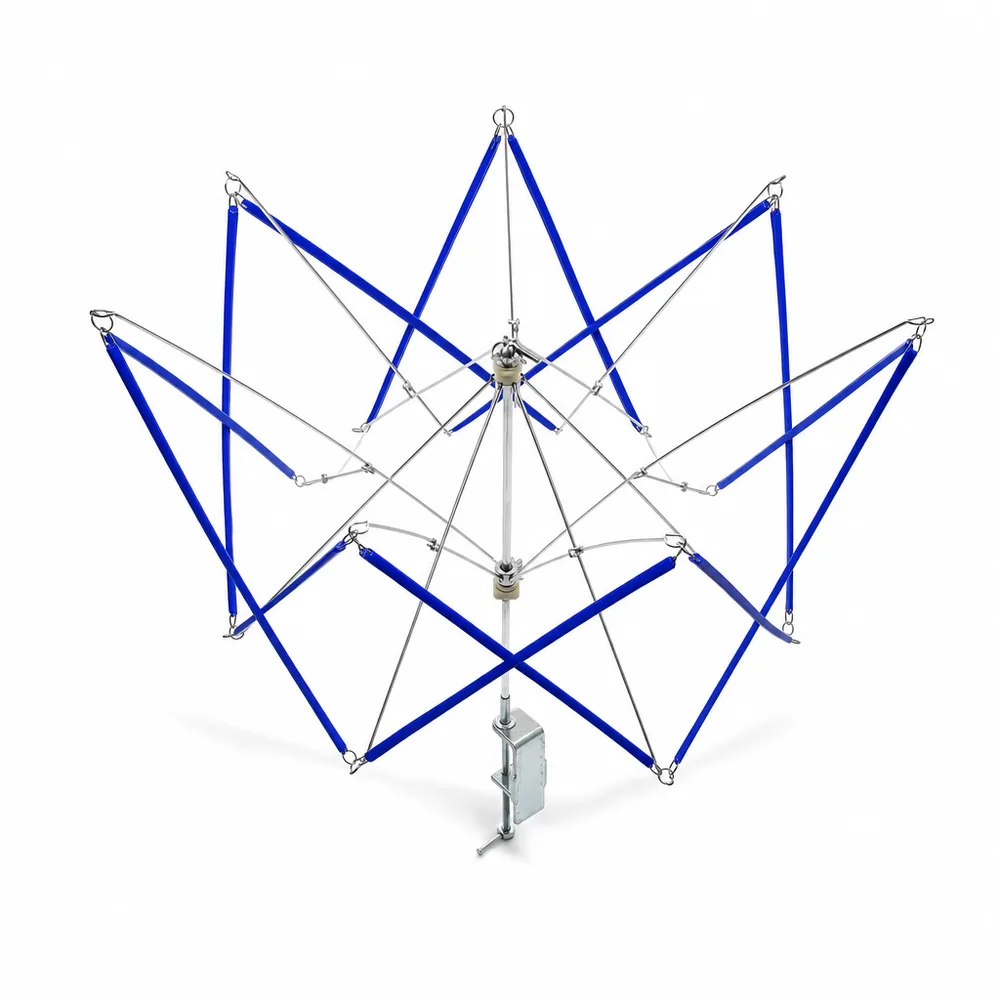
Where the Amish design assumes a permanent home, the umbrella design assumes it has none. It borrows a table edge, does the job at working height, then disappears.
Height of the Skeinwright umbrella swift frame above the clamp (42 cm)
— Skeinwright published specification sheet, 2026
Footprint: what each design claims while you wind
Here the geometry does all the talking. An Amish tabletop swift spins flat, so the table has to give it a clear circle at least as wide as the open arms, for as long as the winding lasts. Anything inside that circle gets swept: the teacup, the pattern, the elbow of whoever shares the table. The design claims the middle of the surface, fine on a craft table and negotiable everywhere else.
The umbrella swift claims an edge instead of a middle. Because the clamp grips at the rim of the table, the shaft stands at the boundary and the circle of yarn rides partly over the table, partly over open air. The surface behind it stays usable while the skein turns. In exchange it asks for height: the frame stands upright, so a low shelf above a narrow ledge can crowd the spinning loop.
Neither footprint is zero. But they are different kinds of space, and most homes have more spare edges than spare circles. If your table is glass or has a thick rounded rim, the clamp needs a flat lip to bite; the step by step guide covers how to check that in a minute.
Skein capacity: fixed pegs against sliding ribs
Both designs adjust, and they adjust differently. The Amish cross adjusts in steps. Each set of peg holes is a fixed diameter, so the loop either sits on the step below, slightly relaxed, or stretches to the step above. The steps on a well made frame are close enough that this rarely matters, and the positive click of a peg in its hole is part of why people love the type. The upper limit is whatever the maker built, and it varies frame to frame.
The umbrella adjusts continuously. The ribs slide outward through every diameter from nearly closed to fully open, so the hank itself decides the setting: you spread the ribs until the loop stops sagging and no further. A short loop is never forced to reach the next step, which is exactly how fragile yarn gets strained before the first crank. On ours the full spread is 21.65 in (55 cm), and every diameter below that is available, not just a row of preset stops.
We publish no maximum hank circumference for our frame, because the specification sheet does not state one, and converting a diameter into a circumference rating would be arithmetic dressed up as a fact. The loop simply needs to sit taut somewhere below full spread.
Full open diameter of the Skeinwright umbrella swift (55 cm)
— Skeinwright published specification sheet, 2026
Speed: how each frame behaves once yarn is moving
A swift never turns alone; something pulls, usually a ball winder cranking in bursts. How the frame answers those bursts is a matter of mass, and the two designs sit at opposite ends of it.
The hardwood cross is the heavy one, and weight behaves two ways. At a steady, moderate pace it is glorious: the cross settles into a smooth rhythm, absorbs small jerks in your cranking, and runs almost silently. Stop suddenly, though, and that same momentum keeps the cross turning a moment longer, feeding slack yarn that settles over the pegs and waits to catch on the next pull. Experienced users learn to slow down before they stop.
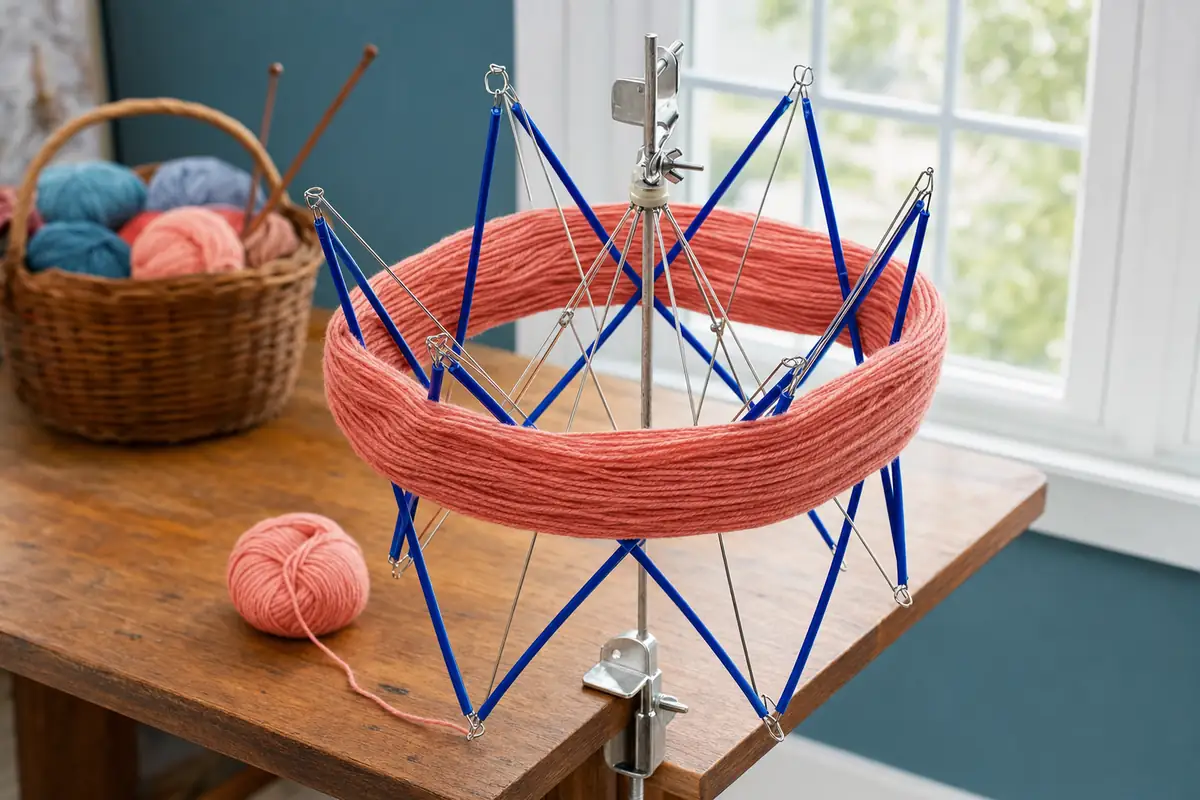
The iron umbrella frame is the light one. It has little momentum of its own, so it starts when the winder pulls and stops almost when the winder stops. Stop-and-go winding, the kind real evenings are made of, with a kettle boiling and a child asking for something, suits it well: less overrun, less slack, less of the loop drooping between bursts. What you give up is the flywheel calm of the heavy cross at continuous speed. Both designs get a full hank wound; they sound and feel different on the way.
Stability: a planted base against a clamped edge
The Amish tabletop swift is stable the way furniture is stable. Its weighted base sits in the middle of the table, its center of gravity is low, and the flat spin generates no sideways lever against the mount. Short of shoving it, it does not move. This is the design's quietest advantage and the one that shows most with fine, snaggy fibers, where any lurch of the frame telegraphs straight into the strand.
The umbrella swift is stable the way a clamped lamp is stable: entirely as good as its grip. The standing shaft works as a lever on the clamp, so the screw has to be tightened more than feels polite and checked again after the first hank. Done properly on a bare, flat edge, the frame holds through fast winding without complaint. Done lazily on a rounded or slippery rim, it will creep, and the swift gets blamed for the mounting. Our reviews page collects what buyers said after real use, clamp included.
Storage: the flat lattice against the folded stick
Winding is minutes; storage is the rest of the year, and it is where the two geometries finally stop pretending to be equivalent.
The Amish cross does not really fold. Some frames lift off the base and store as a flat lattice, some unpeg into a bundle of loose parts, and many are simply meant to stay assembled on the table they live on. Again: not a defect, a declaration. The design was drawn for a household with a craft room, and in that household it never needs to be put away at all.
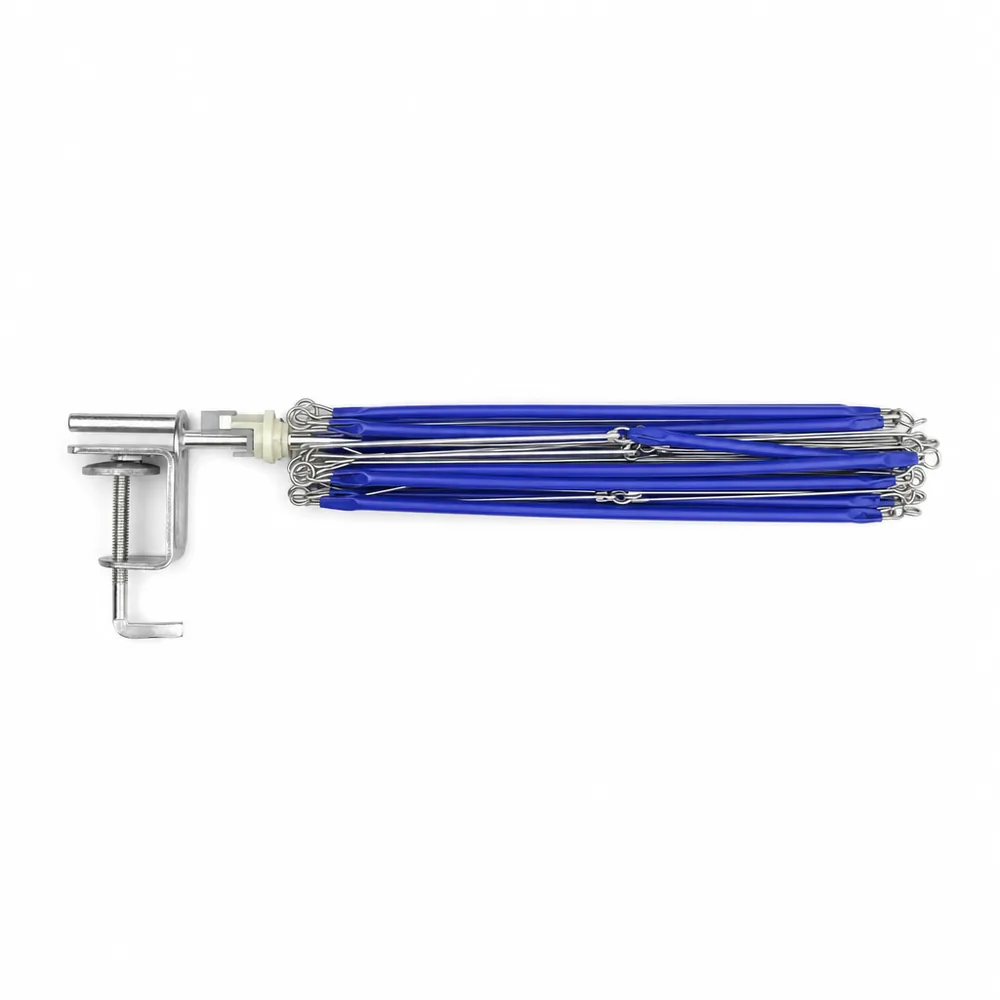
The umbrella swift was drawn for the other household. Loosen the clamp, let the ribs fall inward, and the whole tool closes to a slim shape that slides into a drawer, a project bag or the gap behind a bookcase. Nothing unscrews, nothing comes apart into pieces that can wander off. It is the one move in this whole comparison that the Amish design cannot copy, because the folding is the shape.
Side by side, design against design
| Point | Amish tabletop swift | Umbrella swift (ours) |
|---|---|---|
| How the skein sits | Lies flat on upright pegs, held partly by gravity | Stands around the ribs, held open from inside |
| Working footprint | A clear circle in the middle of the table | A table edge; the circle rides partly over open air |
| Diameter setting | In steps, peg hole by peg hole | Continuous, any diameter up to 21.65 in (55 cm) |
| Behavior at speed | Smooth momentum, keeps turning briefly after you stop | Light frame, starts and stops with the winder |
| Stability | Weighted base, planted like furniture | Screw clamp; solid when tightened on a flat edge |
| Storage | Stays assembled, or stores as a lattice or loose parts | Folds flat in one movement to a slim stick |
Which design belongs on your table
Choose by the room, and the choice mostly makes itself. A dedicated craft space with a table the swift can keep, a taste for stepped, positive adjustments and a flat, planted spin: that is Amish territory, and the design will serve it beautifully for a very long time.
A shared table, a home where tools go away after use, skeins that arrive in every size, winding that happens in interrupted bursts: that is the umbrella's home ground, and it is the design we chose to sell. The Skeinwright umbrella swift clamps to the edge, opens to any diameter up to 21.65 in (55 cm), stands 16.54 in (42 cm) tall, folds flat in one movement and costs $39.95 with free shipping. Pair it with the winder in the swift and winder set at $57.95 and the whole hank-to-ball job is covered in one order.
And if you are still weighing a swift against a chair back or a patient helper, read yarn swift vs the alternatives first: a rotating frame feeds the yarn off one strand at a time, and nothing improvised does that.