· Marguerite Aubin
Squirrel Cage Swift vs Umbrella Swift: What the Cage Does Differently
Put the two frames side by side and the family resemblance is hard to find: an upright post carrying two open drums, like small barrels built from slats, with the skein hanging between them as a long loop; and a mast at the table edge with its ribs spread into a circle and the skein stretched around the outside. Both exist for the one reason any swift exists: a twisted hank has to be held open and allowed to turn, or the first firm pull closes it into a knot.
This guide compares the two as frames: how each takes the skein, how long a loop each can hold, where the strand leaves the tool, how much room each claims, how each behaves once the winder pulls, and where each goes afterwards. If your question is the flat Amish cross against the umbrella, that is Amish vs umbrella yarn swift. New to the tool entirely? Start with what is a yarn swift.
One disclosure first: Skeinwright sells an umbrella swift and no cage. We describe the cage as the people who use it know it, because a reader who buys the wrong frame for their skeins sends it back, and nobody enjoys that.
How a squirrel cage swift carries a skein
The name comes from the exercise wheel. Each drum on a squirrel cage swift is an open cylinder of slats fixed between two end rings, spinning freely on a horizontal axle. Two of those drums sit on one upright post, one above the other. The skein goes on as a loop dropped around both, so it hangs between them like a belt between two pulleys: the top of the loop rests over the upper drum, the bottom passes under the lower one, and the two long sides run vertically between them.
On most frames the upper drum can slide along the post. Loosen its fitting, raise it until the loop stops sagging, lock it. That single move is the cage's way of matching the tool to the skein: instead of spreading a circle wider, you lengthen the belt. Then, as the strand is drawn off, both drums turn together and the whole loop travels round while the post and base stay still.
Everything about the design assumes yarn arrives in long loops. The cage grew up beside spinning wheels, where a freshly spun skein comes off a reel or a niddy-noddy as a loop far longer than any commercial hank. Holding that loop between two drums is what the geometry is built for, and it explains most of what follows.
How an umbrella swift carries a skein
An umbrella swift answers the same problem with one moving frame instead of two drums. The shaft stands vertical on a screw clamp that grips the table edge from above and below, and ribs hinged along the shaft spread outward when the collar is pushed up, exactly like the object it is named after. The skein sits around the outside of the ribs, held open from the inside, and the entire ribbed frame turns on the shaft as yarn leaves it.
On ours the figures are published and short: the shaft stands 16.54 in (42 cm) above the clamp, the ribs open to any diameter up to 21.65 in (55 cm), and the skeleton is iron with plastic bushings at the pivots. The spec sheet states a measuring tolerance of 1 to 3 cm on hand measured parts, so read those as close values rather than exact ones.
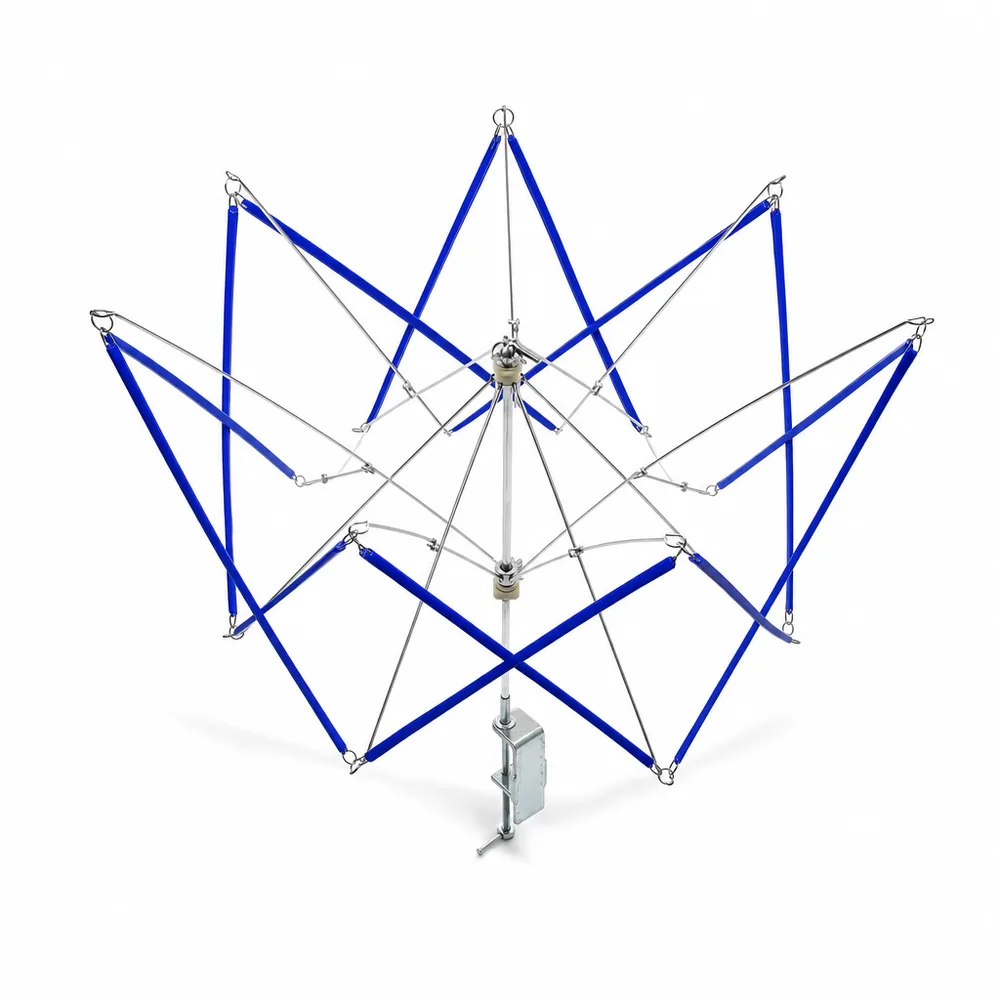
Where the cage assumes a long loop and a room to stand in, the umbrella assumes a bought hank and a table edge it can borrow for twenty minutes. Same purpose, opposite starting point.
Full open diameter of the Skeinwright umbrella swift (55 cm)
— Skeinwright published specification sheet, 2026
Skein length: what each frame can take
This is the round the cage wins, and we say so plainly. Because the loop hangs between two drums, its length is set by the distance between them, and that distance can hold a great deal of yarn: a skein reeled straight off a wheel or a warping reel drops around a cage without complaint. The lower limit is the other face of the coin. Bring the drums as close as the post allows and the loop still has to reach round both, so a very short hank can fall below what some cages hold at all.
The umbrella takes the other end of the range. Its ribs slide through every diameter from nearly closed to fully open, so the hank itself decides the setting: spread the ribs until the loop stops sagging, and stop. A short loop is never forced to reach a step it cannot reach, which is how fragile yarn gets strained before the first crank. On ours every diameter below the full 21.65 in (55 cm) spread is available, which covers the hanks that arrive from a yarn shop, a dyer or the back of a cupboard.
We publish no maximum hank circumference for our frame, because the specification sheet does not state one and turning a diameter into a circumference rating would be arithmetic wearing the clothes of a fact. The loop simply needs to sit taut somewhere below full spread. A spinner's loop measured by the armful is the cage's job; the hank with a label on it is the umbrella's.
Tension and feed: where the strand leaves the frame
A strand leaves a cage off the curved face of a drum. There is no peg or rib end to catch on, only rounded slats, so a fine or fragile yarn slides away with very little drag. Tension comes from the loop's own weight and from how far the upper drum is raised, and both are gentle: the cage holds a skein the way two hands would, relaxed and round.
A strand leaves an umbrella off the outside of the ribs. The ribs hold the loop taut from inside, which keeps every strand separated from its neighbours, which is the whole reason a rotating frame beats a chair back: the loop turns together and the strand you are pulling never crosses the ones beside it. Set the spread to taut, not stretched, and the feed stays even from first yard to last. The step by step guide shows the setting in a minute.
In the hand the difference is one of touch: the cage is soft with the loop, the umbrella crisp. Both feed a winder cleanly once set right.
Footprint and mounting: a standing frame against a clamped edge
A cage is a piece of furniture. The post stands on a base, on the floor or on a table, and the drums hang above it, so the tool occupies a tall rectangle of air, the height of the post by the width of a drum, and the skein shares that rectangle. Nothing spins except the drums, so the footprint does not sweep the table the way a flat turning cross does. It does stay where it is put: a base sized to carry two drums and a long skein is not a thing you slide aside for dinner.
The umbrella claims an edge instead of a base. The clamp grips at the rim, the shaft stands at the boundary and the circle of yarn rides partly over the table, partly over open air, leaving the surface behind it free. Our clamp is a wide screw jaw, checked on a thick oak edge, a thin laminate shelf and a glass-topped desk; it holds on all three, and a folded tea towel between the jaw and a glossy surface adds grip and protects the finish. The how we test page has the full method.
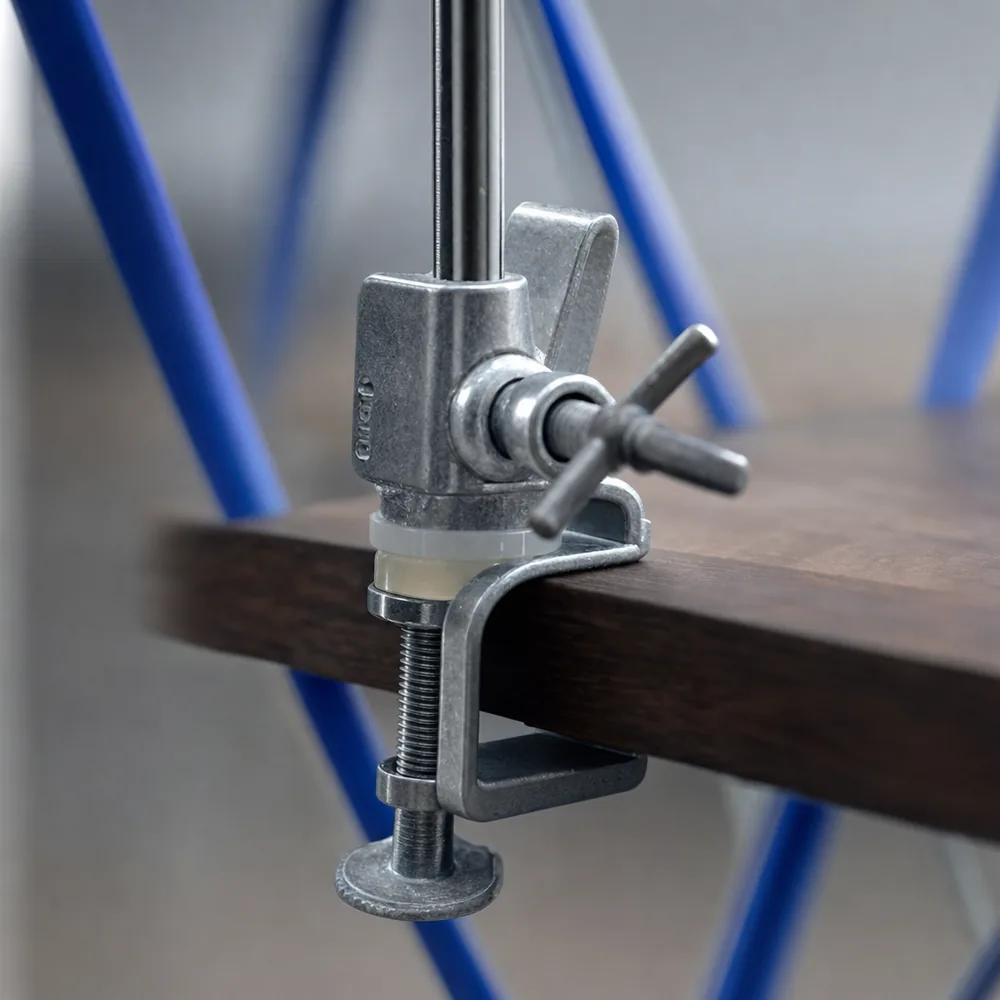
In exchange the umbrella asks for a lip the clamp can bite: a bare, flat edge, tightened firmly and checked again after the first hank, never a rounded rim or a tablecloth. The cage asks nothing of the table and a great deal of the room.
Speed and stop: two drums against one light frame
A swift never turns alone; something pulls, usually a ball winder cranking in bursts. The cage answers those bursts with two rotating masses. At a steady pace the drums settle into a rhythm and absorb the small jerks in your cranking. Stop suddenly and both drums keep turning a moment longer, feeding slack that drapes over the lower drum and waits to catch on the next pull. People who wind on a cage learn to slow down before they stop.
The iron umbrella frame is the light one. It carries little momentum, so it starts when the winder pulls and stops almost when the winder stops. Winding in interrupted bursts, with a kettle boiling and someone asking where the scissors are, suits it: less overrun, less slack, less drooping between pulls. What you give up is the flywheel calm of two drums at continuous speed. Both frames get a full hank wound; they sound and feel different on the way.
Storage: what stays assembled and what folds
Winding is minutes; storage is the rest of the year, and it is where the two frames stop pretending to be equivalent. A cage does not fold. Post, base and drums stay assembled, and the tool is stored the way a chair is stored: by finding it somewhere to stand. In a studio with a wheel, that somewhere already exists. In a flat with one table, it does not.
The umbrella was drawn for the flat with one table. Loosen the clamp, let the ribs fall inward, and the whole tool closes to a slim shape that slides into a drawer, a project bag or the gap behind a bookcase. Nothing unscrews, nothing comes apart. Folding is the one move here the cage cannot copy, because on an umbrella the folding is the shape.
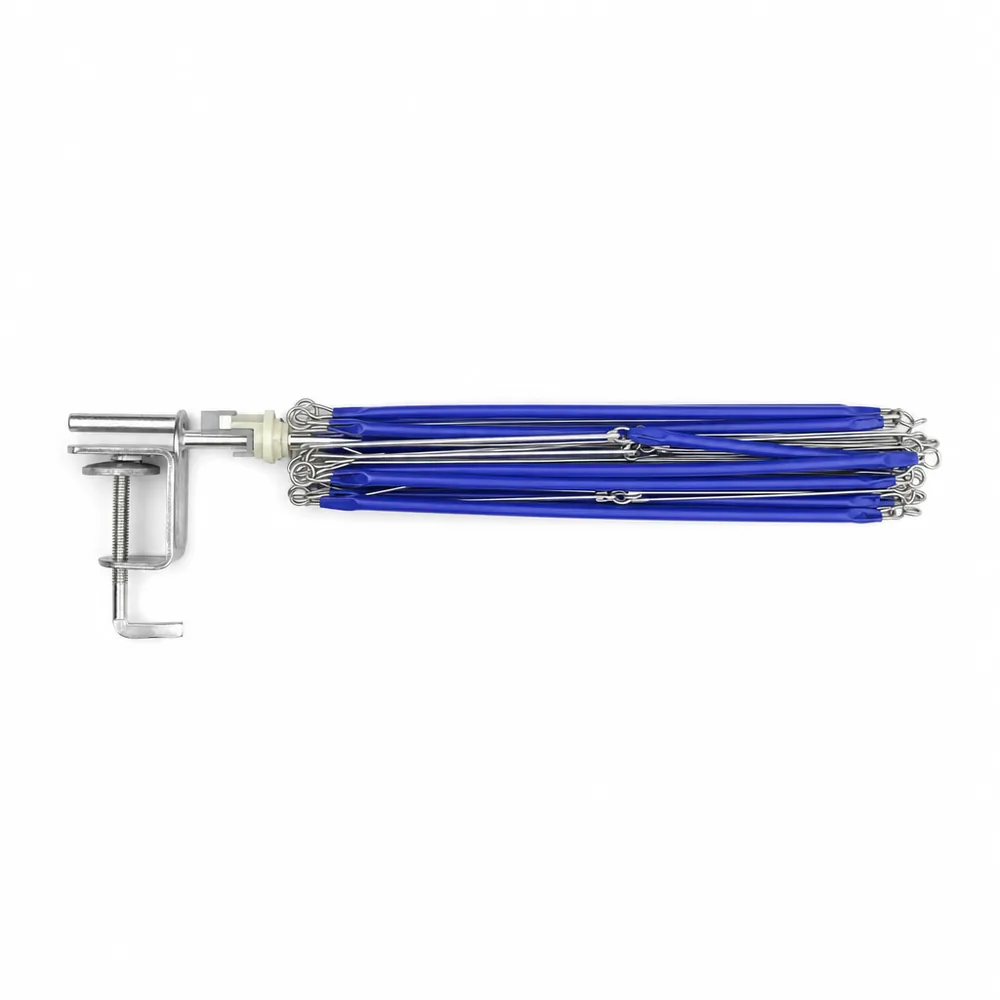
Height of the Skeinwright umbrella swift frame above the clamp (42 cm)
— Skeinwright published specification sheet, 2026
Side by side, cage against umbrella
| Point | Squirrel cage swift | Umbrella swift (ours) |
|---|---|---|
| How the skein sits | Hangs as a loop between two drums on a post | Stands around the ribs, held open from inside |
| What moves | The two drums, each on its own axle | The whole ribbed frame, on the shaft |
| Matching the skein | Slide the upper drum to lengthen the loop | Spread the ribs to any diameter up to 21.65 in (55 cm) |
| Skein length | Takes very long reeled loops; a very short hank can fall below its reach | Takes any hank that sits taut below full spread |
| Where the strand leaves | Off the rounded face of a drum, no pegs | Off the outside of the ribs, strands kept apart |
| Mounting | A base on the floor or the table | Screw clamp on a flat table edge |
| Behavior at speed | Two rotating masses, keep turning briefly after a stop | Light frame, starts and stops with the winder |
| Storage | Stays assembled, needs a place to stand | Folds flat in one movement to a slim stick |
Which frame belongs on your table
Choose by the skeins you actually wind. Loops that come off a wheel or a reel by the armful, a room where a tool can stand on the floor for years, a taste for a soft, gravity-fed hold: that is the cage's ground, and the design serves it well.
Hanks bought from a shop or a dyer, a table shared with the rest of the household, a drawer where the tool waits between projects: that is the umbrella's home ground, and it is the design we chose to sell. The Skeinwright umbrella swift clamps to the edge, opens to any diameter up to 21.65 in (55 cm), stands 16.54 in (42 cm) tall, folds flat in one movement and costs $39.95 with free shipping and a 30 day money back guarantee. Pair it with the winder in the swift and winder set at $57.95 and the whole hank-to-ball job is covered in one order.
Twenty-six verified buyers rated this swift 5.0 out of 5, and the reviews page keeps every comment they left, clamp included. Clamp it on, open it to your hank, wind, fold it away: that is the whole routine.