· Marguerite Aubin
Why a Yarn Cake Collapses, and What Holds a Good One Together
A cake is a structure, and like any structure it tells you how it was built. A slumped cake is almost never a mystery: its shape records what happened between the hank and the spindle. Read the cake and you know which part of that journey went wrong.
This guide is about the finished object rather than the routine. If you want the routine, how to wind a skein of yarn covers the methods end to end. What follows is the structural half: what supplies the grip, the four ways it is lost, and how to check a cake before you cast on.
What actually holds a yarn cake together
Nothing glues a cake. There is no core, no spool and no former left inside it. A cake stands up because of friction between strands that lie across each other, and that crossing comes from two things happening at different speeds at once.
The first is rotation: the spindle turns, carrying the growing cake with it, so the yarn is drawn on continuously. The second is the feed point. The strand arrives from a fixed place in space, held at a set height and angle by the yarn guide, while the surface it lands on is tilted and turning beneath it. Because the spindle is tapered, the touchdown point travels up and down the cone as the cake builds, and because those two rhythms do not divide evenly, no wrap lands exactly on the one before it.
The result is a lattice. Every strand is pinned across dozens of others at a shallow angle, and each crossing is a tiny brake. A hundred are irrelevant; a hundred thousand are a solid object. That is why a cake survives being dropped in a bag and carried across town.
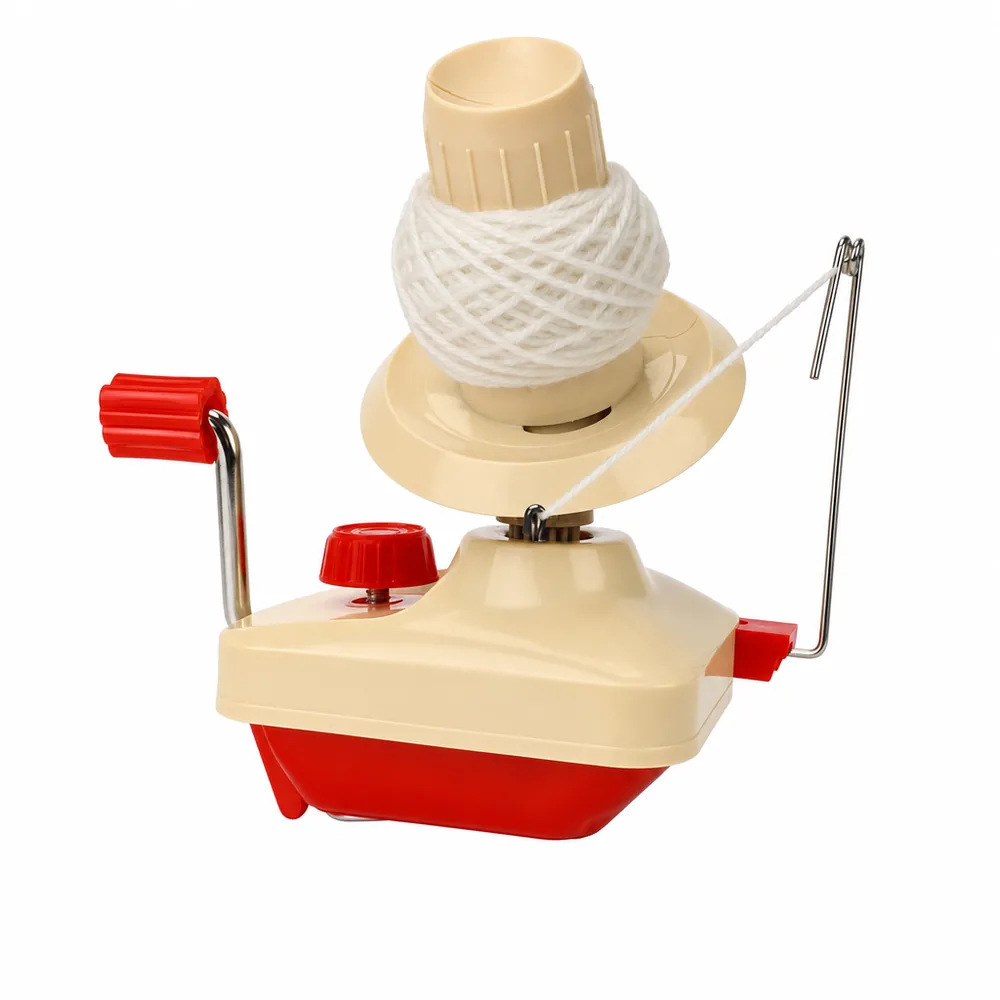
Two features come free with that geometry. The middle stays hollow because the spindle occupies it throughout, and the base stays flat because the disc at the foot of the spindle gives the first layers something square to build on. Neither is decorative: the hollow lets you knit from the center, the flat base stops it rolling.
Parts named on the hand crank winder: spindle, yarn guide, knob, geared base, handle and clamp
— Parts diagram, 2026
Collapse one: the center pull swallows itself
The symptom usually arrives a third of the way into a project. You tug the inner tail and instead of a smooth yard you get a fist-sized clump, followed by the middle of the cake folding inward. From there it becomes a nest, untangled from the inside out.
The cause is almost always the anchor. You tuck the tail into the slot at the top of the spindle, and the right amount is two or three turns with a few inches hanging free. Wrap it fifteen times because that feels more secure, and those fifteen wraps sit at one height in parallel, with no crossing at all. That parallel bundle is the one part of the cake with no internal grip, and it is precisely the part you pull on first.
The second cause is how the cake came off. Lifting straight up slides the hollow off the cone and leaves the walls standing. Twisting or tipping it sideways drags the innermost layers around the taper and breaks the crossings holding the middle open. The damage does not show at once: the cake looks fine in the basket, then gives way the moment the center takes load.
If a cake starts to swallow itself mid-project, knit from the outer end instead. The outer layers still have all their crossings, and the cake will sit in a bowl while you use them.
Collapse two: the cake grows into a cone, a barrel or a lopsided lump
A cake shaped like a spinning top, fat in the middle like a barrel, or higher on one side is telling you that the relationship between the feed point and the spindle changed while it was being built. Those two are the fixed and the moving part of a simple machine, and the cake records what each did.
The most common version is a strand that never went through the yarn guide. It happens easily: you are watching the hank, you thread the tail straight onto the spindle, and away you go. Without the guide the strand arrives at whatever angle your hand holds it, which drifts constantly, so you get dense bands where your hand was steady and loose bands where it wandered. The guide is not there to tidy the yarn. It exists to make the arrival angle boring, and boring produces an even wall.
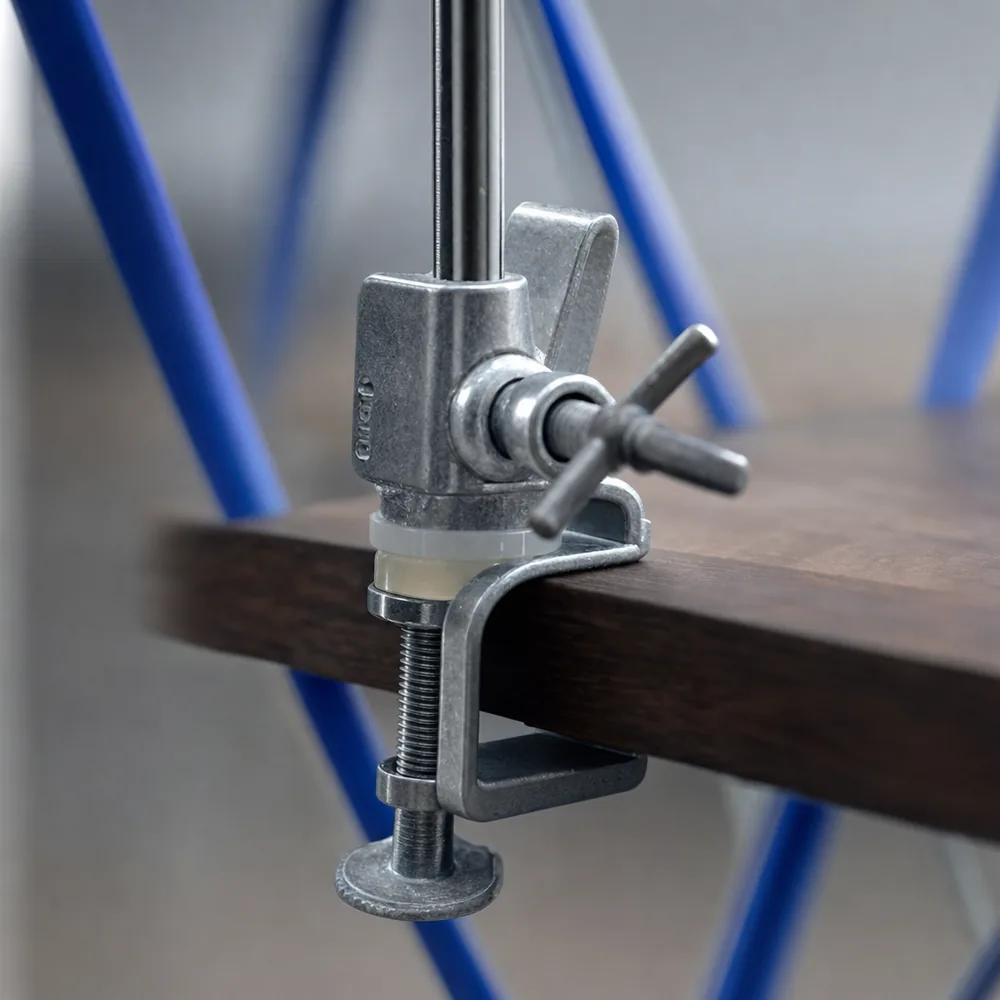
The other version is a tool that moves. A clamp loosened by a quarter turn lets the body rock a fraction on every rotation of the crank, and that is a shift on every layer. The cake leans because it has faithfully recorded the wobble. This is why the clamp deserves the extra half turn, and why it is checked as its own criterion in the ball winder buying guide.
Cranking speed matters less than people assume, as long as it is steady. Slow or brisk, an even turn builds a good wall. What builds a bad one is surging: three fast turns, a pause, three more. The pauses are where the layers pile up.
Collapse three: the cake that comes out hard as a stone
This one does not slump; it does the opposite, and most knitters never notice until the finished garment tells them. The cake is dense, heavy for its size, and when you press it with a thumb the dent stays. Yarn wound this way comes off limp weeks later, and the stitches it makes do not match the ones you swatched.
The cause is tension applied during winding, and the usual source is the winding hand. It is natural to pinch the strand between finger and thumb to keep it tidy. That pinch is a brake, and everything downstream of it goes onto the spindle stretched. Wool is elastic, and elastic held under load long enough stops springing back. A cake sitting in a basket for a month under its own winding tension is doing exactly that, from the inside.
There is a compounding effect too. Each new layer squeezes the ones below it, so tension applied at the start is multiplied by everything wound afterwards, and the center of an over-tight cake carries far more load than the outside.
The fix takes one attempt to learn. Rest your free hand on the strand a foot back from the guide rather than gripping it, palm open, so you are feeling for resistance instead of supplying it. The yarn should slide under your hand. If it dents your fingers, the cake is being built too tight.
Collapse four: smooth fibers that will not lock
Everything above assumes the crossings hold once they are made. With some fibers they do not, and this is a property of the yarn rather than a mistake anyone made. Silk, bamboo, smooth plied cotton and many superwash treatments are slippery by design: the surface that makes them lovely to knit supplies very little friction against itself.
On a slippery yarn the lattice is built correctly and then slowly gives way, usually from the top edge downward, because each crossing offers less grip than the same crossing in a woolly, slightly hairy yarn. Mohair and other haloed fibers fail in the opposite direction: they grip too well, and clumps lift away together rather than feeding one strand at a time.
Both respond to the same two adjustments. Wind more slowly, which lets each layer settle before the next lands on it, and build a smaller cake, because the failure is driven by the weight of the wall above each crossing. Two modest cakes from one large hank are far more stable than a single tall one.
The tension you cannot see until the cake is finished
One upstream cause shows up in all four failures, and it is not on the winder at all. It is whatever holds the hank open on the other side of the table.
A holder that rotates freely gives yarn away continuously: the pull of the winder turns it, and the strand arrives at a steady rate. A holder that does not rotate cannot. On a chair back or a pair of knees, the loop stays still and the yarn drags across its own neighbors to get out. Resistance builds until a strand slips free, a slack burst follows, then resistance builds again. The winder writes that into the cake as bands of hard and soft.
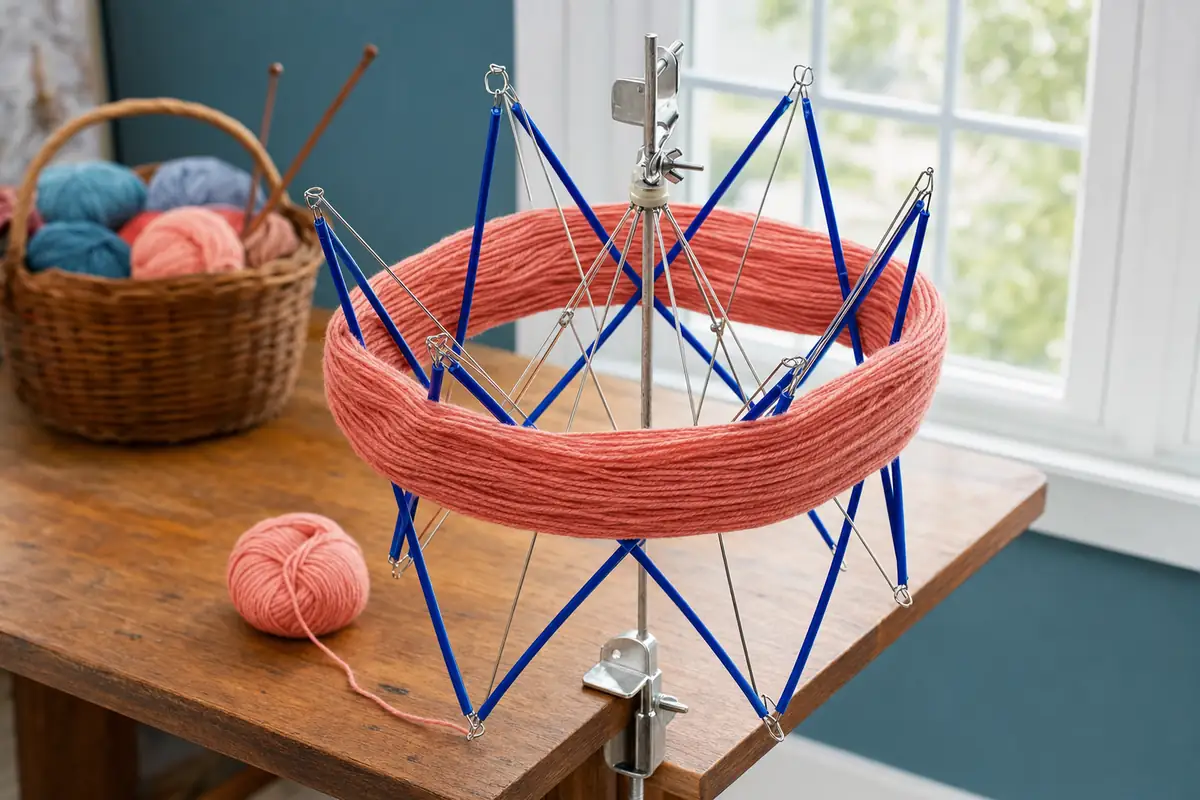
Those bands are the fingerprint of a stationary holder, and they explain why a cake can slump even when the winding hand was faultless and the clamp was tight. The umbrella swift removes that variable: the arms carry the loop, the frame turns under the winder's pull, and the yarn leaves in the order it went in. It opens to 21.65 in (55 cm) across and folds flat afterwards, and how to use a yarn swift walks through the clamp and the collar.
This is why the two tools are usually set up together. The swift governs how the yarn arrives; the winder governs how it is stacked. A cake is only as even as the least even of those two jobs, which is why we offer the swift and winder set at $57.95.
Average across 285 verified four and five star ratings of the hand crank ball winder
— Skeinwright verified buyer ratings, 2026
How to read a cake before you knit from it
Thirty seconds of checking saves an evening of untangling. Set the cake on the table and look at it before it goes into the basket.
| What you see | What it tells you | What to change |
|---|---|---|
| Flat top, flat base, straight walls | Guide, clamp and hand all held steady | Nothing. This is the target |
| Visible criss-cross pattern on the wall | The layers are locking as they should | Nothing |
| Bands of tight and loose around the wall | The yarn arrived in surges from the holder | Let the loop turn freely on a rotating frame |
| Leaning, conical or barreled | Something moved during winding | Retighten the clamp, check the strand runs through the guide |
| Thumb dent that does not spring back | Wound under tension | Open the winding hand, stop pinching the strand |
| Hollow center already closing up | Twisted off the spindle, or anchored too deep | Two turns on the anchor, lift straight up |
One last habit: store cakes standing on their flat base, not on their side. A cake on its side rests on its weakest line, and over a few weeks the wall flattens and the hollow closes. Standing up, the load runs down through the walls, the direction they were built to take.
Good cakes are a skill, and the skill is holding three things steady while a fourth turns. Once your clamp is tight, your guide is threaded and your hand is open, every cake comes out the same. The hand crank ball winder is $24.95 with full specifications on its page, the reviews page collects buyer photographs, and the rest of our writing is in the guides index.