· Marguerite Aubin
Ball Winder for Yarn: A Buying Guide
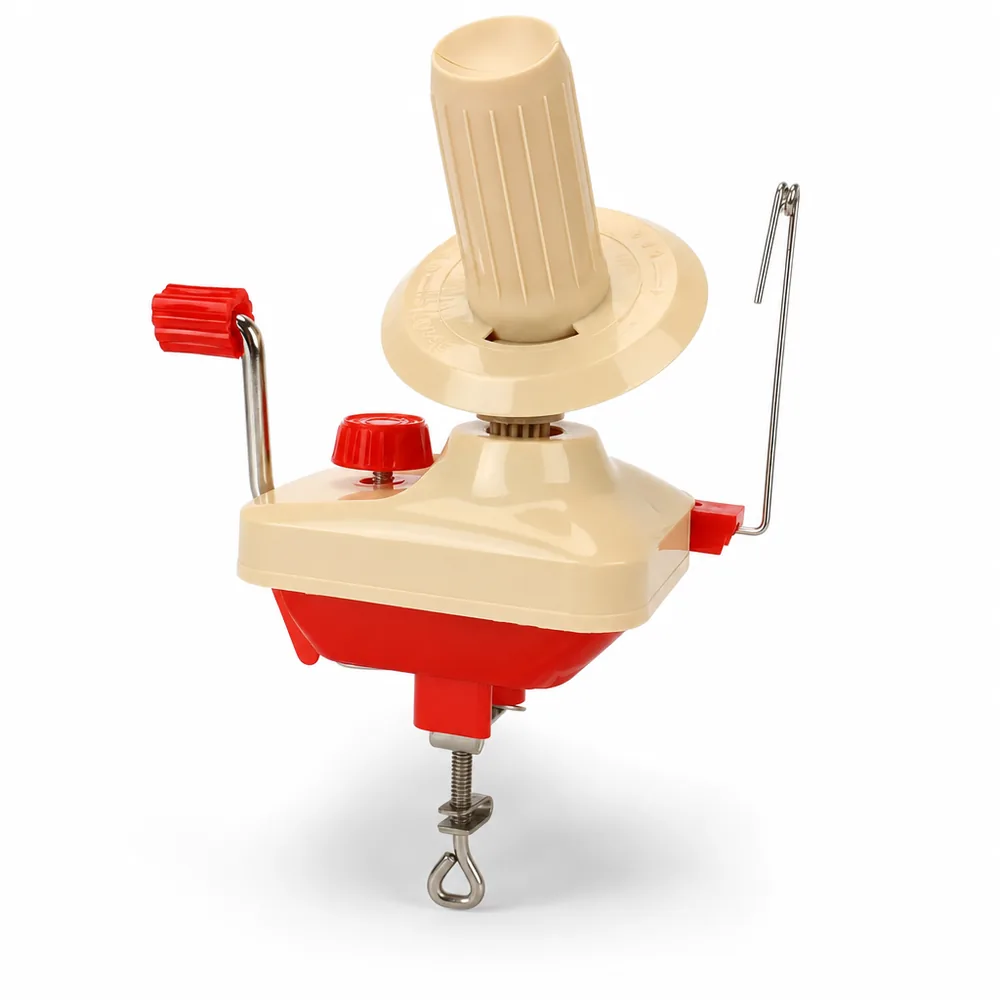
The ball winder is the half of the job people think about last and use most. A swift presents the yarn, and the winder is what actually turns a loop into something you can knit from. Get the winder right and the whole routine becomes pleasant. Get it wrong and you will find yourself steadying a wobbling spindle with one hand while cranking with the other.
What a ball winder does, and what a skein winder is
A ball winder holds a spindle at an angle and rotates it through a small geared drive as you turn a crank. Because the spindle is tilted, the yarn lays down in crossing layers instead of stacking in one place, and the result is the flat cake you see in yarn shops. The center tail stays accessible, so you can knit from the middle and the cake sits still rather than rolling under the sofa.
The phrase skein winder causes real confusion. Some sellers use it for the winder described above. Others use it for the swift that holds the skein, and a few use it for a niddy noddy, which is the tool used to turn finished yarn back into a hank for storage or dyeing. When a listing says skein winder, look at the photograph. A crank and a spindle mean a ball winder. Arms in a circle mean a swift. Both tools together are on our set page.
Hand crank or electric
Electric winders exist and they are genuinely useful behind a shop counter, where somebody winds dozens of skeins a day. At home the calculation is different. An electric unit costs considerably more, it needs a power outlet next to your table, it is one more thing that can fail, and it removes the feedback that stops trouble early. When you crank by hand you feel a snag a second before it becomes a knot. A motor does not.
There is also a control argument. Hand cranking lets you slow down for mohair, laceweight and anything with a halo, and speed up for smooth plied wool. We sell a hand crank model because it is the right tool for the volumes a home knitter actually handles.
| Point | Hand crank | Electric |
|---|---|---|
| Price | Low, ours is $24.95 | Considerably higher |
| Setup | Clamp to a table and start | Clamp plus a power outlet within reach |
| Feedback | You feel every snag through the handle | The motor keeps pulling regardless |
| Delicate fibers | Easy to slow down mid-skein | Speed control varies by model |
| Best for | Home knitters and spinners | Shops and dyers winding all day |
The parts that decide whether you like it
Six parts do all the work, and they are named the same way everywhere: the spindle, the yarn guide, the knob, the geared base, the handle and the clamp. Knowing the names makes listings much easier to compare.
The clamp is the part that ruins a cheap winder. It has to hold the body still while the geared base fights back, so check that the jaw opens far enough for your table and that the screw has a decent thread. The yarn guide is the arm that feeds yarn onto the spindle, and it should be smooth where the yarn touches it. The geared base should turn evenly with no gritty spot at one point in the rotation. The spindle should sit firmly once assembled, with no wobble at the tip. The knob holds the assembly together and the handle should feel comfortable after a few hundred turns rather than after ten.
Assembly is a thirty second job. The assembly note states it simply: set the spindle into the geared base by aligning the notches, then hold the base and turn the spindle clockwise to secure it. If the spindle wobbles afterwards, the notches are not seated, so take it apart and try again rather than forcing the crank.
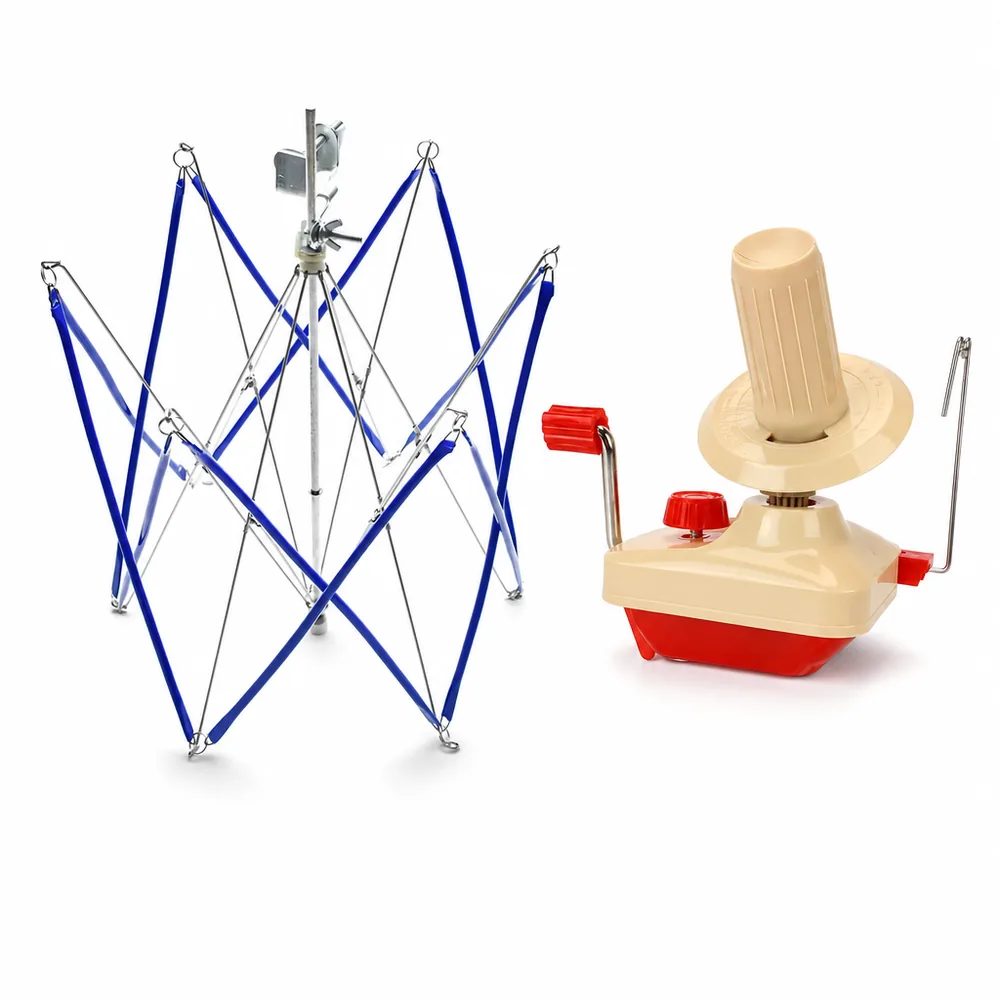
Height of the Skeinwright hand crank ball winder, 19 cm, with a 5.35 in by 3.54 in footprint
— Skeinwright published specification sheet, 2026
How to judge a winder
| Criterion | Why it matters | What good looks like |
|---|---|---|
| Clamp reach and grip | A winder that slides is a winder you fight | Jaw that opens wide enough for your own table lip |
| Spindle stability | Wobble ruins the cake shape | A positive locking method, such as aligned notches |
| Guide smoothness | Rough guides fluff delicate yarn | A rounded contact surface with no seams |
| Gear feel | A gritty spot becomes a jolt every rotation | Even resistance through a full turn |
| Published dimensions | You need to know it fits your workspace | Height, length and width all stated |
| Honest capacity claims | Inflated figures are the most common exaggeration | A seller who says what is measured and what is not |
That last row applies to us as well. The figures on this page are the measured ones: height, length and width, all published on the specification sheet. Judge capacity by the spindle you can see in the photographs, and split very large skeins into two cakes, which wind faster and stack more neatly in a basket.
What ours is, in plain figures
The Skeinwright winder is a hand crank model in cream and red. It measures 7.48 in (19 cm) high, 5.35 in (13.6 cm) long and 3.54 in (9 cm) wide. It clamps to a table edge, it assembles in seconds and it costs $24.95. Paired with the swift, the two of them cover the whole route from twisted hank to knittable cake, which is why we offer them together at $57.95.
Buyer feedback is the strongest evidence we have, and there is a lot more of it for the winder than for the swift. Across 285 verified four and five star ratings the average sits at 4.9. Comments cluster on the same points we have made here: it is smooth for the money, it wants a firm clamp, and slow cranking gives the best cakes.
Average across 285 verified four and five star ratings of the hand crank ball winder
— Skeinwright verified buyer ratings, 2026
Keeping it working
A hand crank winder needs almost nothing. Keep the geared base free of fluff, because wool fibers gather in the teeth and eventually make the turn feel notchy. Wipe the spindle now and then so the cakes slide off cleanly. Do not oil the gears unless the instructions say to, since oil traps fiber and makes the problem worse. Store it assembled if you have a shelf, or take the spindle off if it lives in a drawer.
Next steps: the ball winder page has the full specification, the reviews page collects buyer photographs and comments, and how to wind a skein of yarn shows the winder in use. If you still need the other half, read what a yarn swift is, how to use a yarn swift, the wooden versus metal comparison or our take on swift alternatives. Everything is listed on the home page and in the guides index.